 It’s one of those strange twists of fate that adulthood offers in spades: bitter, it turns out, is better. Taste profiles that once made you wretch, be it beets, beer, or the dreaded Brussels sprout (which I still contend was widely loathed nearly exclusively due to entire generations of moms who refused to do anything besides boil the once woefully underrated cruciferant), now occupy a favorite place at the table.
Add to that illustrious list gin, and in particular its most deliciously voluptuous, if certainly bitter, manifestation: the Negroni. I remember my first sip of gin, stealing one from my dad during a family vacation to The Lighthouse Inn on Cape Cod…I don’t think I ever dared such a thing again. Yet the older I get, the more I appreciate not only the complexity of gin on its own, but it’s versatility as a base spirit in cocktails.
None more perfectly-suited than in the Negroni. As simple and failsafe as it is delicious and refreshing, the Negroni occupies a special echelon in this notable niche: a time-honored, satisfyingly complex cocktail that, like the Old Fashioned, is as easy to make as it is to enjoy. And as is often the case in matters of sartorial beauty: its simplicity is at the heart of its beauty.
3 ingredients. Equal parts. And yet several notable riffs that make the Negroni more than just a summer standby, and, thankfully far more interesting than its simple three-by-one formula might portray. The fact that gin is the punching snare in this jazz triplet, despite my initial revolting foray into its juniperian grasp, to me makes it all the more appealing.
Gin, for me, is the ultimate fickle mistress. The first real cocktail booze, which is to say a spirit with added flavor, and the only booze that was consistently coiffed in any significant measure by my parents, it was one with which I had an unwelcome familiarity, due to the aforementioned punitive sneaky sip, as a youth. To the point where I actually believed it was some vast conspiracy to which my folks were party, whereby they claimed to enjoy something that tasted like it was brewed in the backseat of my grandfather’s Cadillac, where ubiquitous Little Trees pine tree air fresheners made the spacious interior smell like a high altitude alpine hike. People don’t actually drink this, right?
Then with adolescence came Doggystyle, and as any committed hip-hop head worth his baggy Girbauds would do, I gave gin ‘n’ juice a faithful whirl. To similar results, to be frank. Somehow, even to my unseasoned palate, orange juice didn’t quite compliment, much less mask, the Pine-Sol profile of even the finest Tanqueray. Must be all that chronic that made this absurd concoction more palatable. Yet I remained semi-committed, simply because my aim to register my allegiance to hip-hop somehow subdued the inherent gag reflex.
Around the same time, I filed away a passing comment made by my erstwhile high school French teacher, Madame Sadowsky, as worldly and real as they came, during the waning days of my senior year. With but one male (me) in a class of 10 students, Madame had taken to keeping it réal et vrai in terms of life lessons beyond the “Où est le bibliotheque?” needed for college life, and in a rather rare moment of frankness among other more couched Catholic school faculty, she extolled to my all-female classmates: “Ladies, and Mr. Fleming block your ears: AVOID GIN. Trust me on this one.”
Interest in her inference picqued, mental note dutifully made, and as my college years wore on, my tastebuds dulled sufficiently enough, apparently, to allow for regular downing of absurd quantities of bad beer, I wondered if perhaps this was at once the reason Snoop, Dre, Domino et al had extolled the virtues of gin, as well as what had led Madame to denounce it: was gin a modern day Brass Monkey? And thus the door was open to again test my tolerance for my dad’s go-to: gin and tonic. So as a spry 19 year old, I set out over my summer break to establish the G and T as my own warm weather go-to, and see if perhaps it could lead to broadened horizons, as it were, with the ladies on campus come fall.
Perhaps not surprisingly, this plan both worked brilliantly, and subsequently backfired violently. By the time winter had arrived, I had developed a taste for gin, and certainly for its ancillary impact on the finer sex. Thus, rather copious amounts of gin and tonic were consumed throughout that academic year. As Maine’s Mud Season gave way to the 3 week cameo of spring, after one particularly juniper-infused night and its subsequent, utterly eviscerating hangover, I literally couldn’t get within a nose of the stuff. For years.
Fast forward roughly 6 of them, and in the middle stages of the beautifully blurry run that is the Wedding Years, with memories of that unfortunate aversion sufficiently subsided, I turned again to gin as my reception beverage of choice. After finally having grown tired of Mount Gay & Sodas, having stopped just short of drinking the entire supply of the Eastern Seaboard over the course of a dozen or so mid-to-late 20s weddings, I sought some other warm-and-fuzzy-buzz-inducing spirit to compliment those nights of epic celebration. In a twist of irony, a scent most associated with winter, that verdant snap of pine, is best imbibed, as it turns out, in the heat of summer. And imbibe I did.
In lieu of tonic, however, the combination of quinine and sodium in which contributed far more heavily to the leaden hangovers of my gin & tonic days, I went with soda as an accompaniment. Hydration: one of many lessons hard-learned that provides an odd mix of pride and embarrassment, and is a hallmark of refining your game as an adult. Like Malcom Gladwell’s 10,000 hour theory. But for much less noble aims. Amazing the lessons we learn once we start losing the ability to instantly bounce back from the ravages of short-term alcohol abuse.
Anyway, another ancillary benefit of aging, it turns out, is the rounding of one’s palate, and an improved ability to tolerate if not outright prefer bitter taste characteristics. Coffee, beer in the near term, later the near endless majesty of digestivos (more on that in a future post) – all nearly unfathomable in my younger days, now at the top of the list of my favorite beverages. And as in the cases of coffee and beer, the more robustly bitter, the more I’m taken to it.
And similar to the somewhat incongruous reality that the rather wintry pine notes of the juniper in gin are actually best suited for summer, the clean yet bracing bitterness of any variety of Negroni, terms one would normally associate with a January day, are also best suited for a warm, al fresco setting.
Beyond just as a beverage, Negronis also embody my conception of ‘flavor’ in the style sense in several ways. Foremost is their simplicity. Legendarily free of fuss, and bordering on too easy to make, a Negroni consists of three, and only three, ingredients: gin, vermouth, and a bitter liqueur (in most cases Campari).
Another crucial determinant of ‘flavor’ evident in a Negroni is balance. Similar to the principle to which I always try to adhere of limiting the number of ostentatious elements in a given outfit to one (either a camo shirt or Go-to-Hell pants or purple velvet loafers – never more than one at a time; either a pocket square or a lapel pin or a tie bar/tack – you get the point). Each ingredient exists in equal measure. The mentholated pine notes of gin, grounded by the earthy herbal smoothness of the bitter, rounded off with the subtly sugary kiss of sweet vermouth. Perfection.
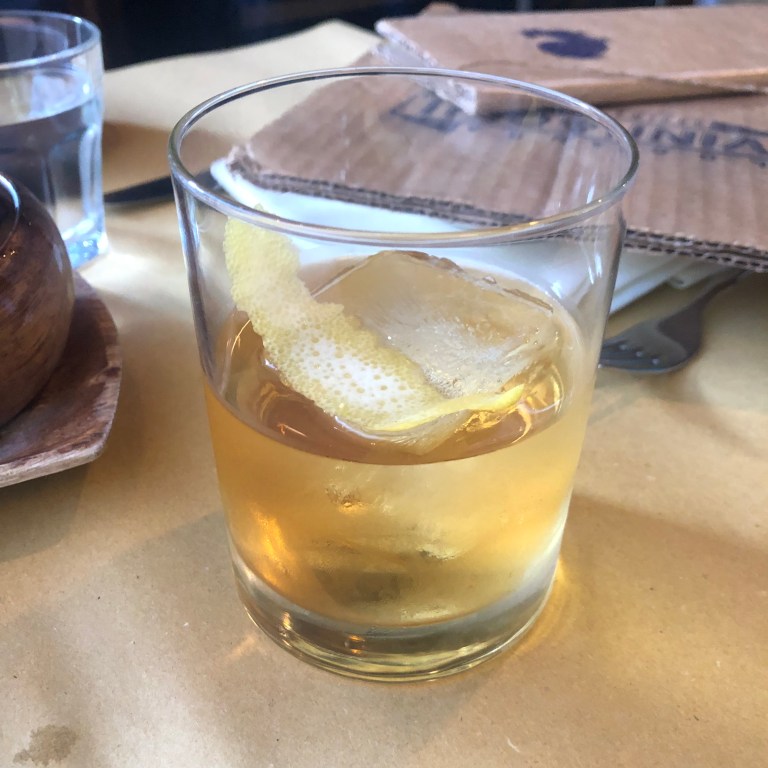
Yet for a simple recipe, the Negroni is also a rather versatile cocktail. Not only situationally – the bitter Campari serving well the role of aperitif, and the sweetness of the vermouth functioning equally well as a post-dinner libation – but there are also a number of variations to roll out with the same core set-up. Siblings with shared DNA but altogether different manifestations: my two favorites being the White (Bonal or Suze Bitter, Dolin Blanc Vermouth), and the Gold (Gran Classico or Breckinridge Bitter, Atxa Blanco Basque Vermouth) – that’s neighborhood favorite Locanda Vini E Olii’s “Negroni d’Oro” pictured above. Three ingredients, three perfect variations. Which is to say nothing of the easy substitution of rye whiskey for gin for a classic Boulevardier, etc.
But perhaps the most notable quality of the Negroni is its inimitable elegance, the product of its having been influenced by three of the most sophisticated ingredients in any barkeep’s well. Add to that the undeniably sexy shelf appeal of its shimmery, ruby red countenance, pierced cleanly at its rim by the warm golden hue of an oily curl of orange rind, and the Negroni functions effectively as an accessory in its own right, as style maven and natty polymath Matt Hranek and his WM Brown Project Instagram account effortlessly exhibit.
Fashion and function rolled into one. And with barely a hint of effort. Leave it to the Italians to show us that in a world of superfluous flourishes and ostentatious accoutrements, true elegance is best found in effortlessness. Sprezzatura, they call it, in reference to dressing, but it’s an approach that applies to all areas of true stylishness. And certainly with regard to booze. Unbothered ease, of which the Negroni is the true embodiment. Or in the words of legendary gin enthusiast Snoop Doggy Dogg: laaaaid back…
Pass that.
 flavormost