Sandwiches, B. Seriously. Sandwiches would land on the short list of things I would select if I was, for some odd, highly unlikely reason, forced to make a list of things I am ‘all about’. I added the ‘B’ in there to drive the point home a bit. ‘B’ being my preferred neutral object, as opposed to ‘son’ (far too affected), or ‘cousin’ (better), or ‘kid’ (acceptable in a pinch, favored alternately with ‘guy’ where I’m from, which is confounding given the number of dudes named Guy around whom I grew up, to the degree that if Jason Kidd ever played for the Celtics and had a son…you get it).
And I figured that opener would resonate more with Millenials, which is super key for the success of any blog (another term I dislike) and because I feel inherently uncomfortable at best with the way overused term ‘all about…’, which is second only to ‘obsessed’ as the term for which I possess the most disdain. This would be the case for its recent ubiquity alone – when did everyone become obsessed with being obsessed with things? – were it not also guilty of making myriad adults, males especially, sound like 14 year old girls.
So, yeah. In modern, shitty Millenial parlance: I’m all about sandwiches, (son). I guess. Just about any great food is made even better when housed betwixt two slices of bread. For most of my life, as with many other food-and-drink-related rankings, the pantheon of sandwich greatness has varied depending on the evolving sophistication of my palate. My earliest memories of selecting my own food are of my daily must-have lunch of a cheese & mayonnaise sandwich on white bread, with an apple juice sidecar. Shouts to my man Teddy, my first non-sibling friend and later de facto leader of our admittedly unfeared middle school ‘posse’. What it meant for my mum was a rather simple daily lunchtime routine. What it meant for me was, inevitably, recurring nightmares.
Confoundingly, my mother, who in her infinite intelligence/instinct pretty much always figured everything out (or worst case conferred with the ever-handy hardbound Dr. Spock), nobody could figure out why. Until, miraculously – and given the collective intelligence of those involved, invoking a miracle is perhaps understating the feat – at one family Christmas gathering the root cause was identified in concert by two of my uncles-by-marriage, both of whom happened to be Prison Guards at the time. Apparently ingestion of too much cheese, and I can only assume processed American cheesefood slices in particular, often led to episodes of night terrors in the prison population. So when my family was collectively trying to sleuth a diagnosis and thereby forge a solution for my ‘teddy bear caught in a monster dungeon castle and I unable to rescue him’ dreamscapes, Uncles Arthur & Jennings (sidebar: the irony of the fact that their names, seeing them now in print for the first time, make them sound more like a turn of the century British traveling bootsmith and/or storytelling outfit, when they were in fact the antithesis of that in real life, is particularly sweet) chimed in with this bit of wisdom re: cheese and it was curtains for both my nightmares and my daily fix.
Luckily I had by that time developed a fondness for bologna. But as with so many slight tweaks to the traditional schoolboy dietary framework my mum would put forth (cutting our 1% milk with a scootch of Skim, adding the broccoli late to her rendition of Chicken Devan, aka Sarah’s Chicken, so as to retain a bit more nutritional value and texture, etc.), not just any bologna. SQUARE bologna! Which, despite its name, wasn’t just a geometric improvement. Square Bologna was also more delicate, more thinly-sliced, and less grainy than its traditional cousin, with a barely detectable rind, unlike the sometimes football-like leathery-ness of pre-packaged, stupid, ROUND bologna. It was, and remains, delicious. Perhaps the most well-constructed of the deli meats, almost a mix of bologna and liverwurst, or a less fatty mortadella.
Only there is no such thing as Square Bologna. Nope. A harsh lesson learned even more harshly during one of the many ‘mental health’ days my mum would afford me as a young gradeschooler. Partially for my own peace of mind, partially, I think, because we’ve always simply enjoyed one another’s company, I’d be allowed to stay home from school, and when timed right, go grocery shopping with her. Which I loved.
So there we are at the deli counter at the local Shaw’s. My mum asks me what I want for lunch next week. “Square Bologna”, I reply, with as much of a hint of “what the fuck do you think?!” as a 7 year old momma’s boy who loves grocery shopping can muster. And with what was the first in an assuringly few number of cases where my faith in my mother was shaken to its core, she turned to the deli man and requested “…and hahffapound of Polish Loaf…” Figuring my Square Bologna order was forthcoming, I sat patiently for a moment. Nothing.
“Mum, Square Bologna.” A smile, a nod, and a look away from her in response. “Mum…”
As she pivoted toward me, she looked for the first time I can remember like she had something she had to tell me, but wasn’t sure how to do it. “Were they out of Square Bologna?”, I asked, seeking the only reasonable explanation I could imagine given what felt like my sudden invisibility in my mother’s eyes.
And in the bluntest, yet somehow gentlest way, my mother’s paradoxical calling card as it turns out, she looked at me and said “Square Bologna is really called Polish Loaf.”
If ‘WTF’ existed at this time I totally would have Snapped it. You know what I mean, Millenials.
Staggered, as I was still in the throes of being a somewhat finicky eater, taking only measured steps toward trying anything wayward from a food perspective, I had trusted my mother’s taste and made the leap to Square Bologna thinking it was something I already knew and loved, but improved. I had even taken to her preferred set-up of enjoying it on Pumpernickel with mayo. How could she?! Intentionally and knowingly tricking me into enjoying something I would otherwise have never tried simply because its name made it sound weird. And her knowing perfectly well both would be the case. The horror.
It wasn’t until later in life that I fully understood the impact of not only such a crucial parental sleight of hand technique, but the utter joy the perspective gleaned from this throwaway incident ended up bringing into my life – the many, near countless, foods and beverages and experiences I have tried that I may never have had she not so deftly set the hook of the joy of exploration and experimentation, via this delicious deli meat, thereby highlighting the silliness of my unfounded prejudices. Culinary and otherwise.
And perhaps not surprisingly, this applies especially and with particular relish to this unique strata of meat products: cured, pork-based luncheon meats. Technically sausages by definition, this classification includes perhaps my favorite sliced meat in Mortadella, as well as the aforementioned Polish Loaf, and several other semi-abominations further down the chain, such as Bologna, Olive Loaf, etc. The common thread, in addition to their European roots, is the technique of grinding/processing various cuts of pork, adding seasoning, textural elements like pistachios, and in some cases fat, in order to help with consistency (and in the case of Mortadella: extra deliciousness), and their having then been cured in an outer casing. The result is a delicate balance of smoothness and meatishness that so perfectly defines this admittedly not-for-everyone section of the deli counter.
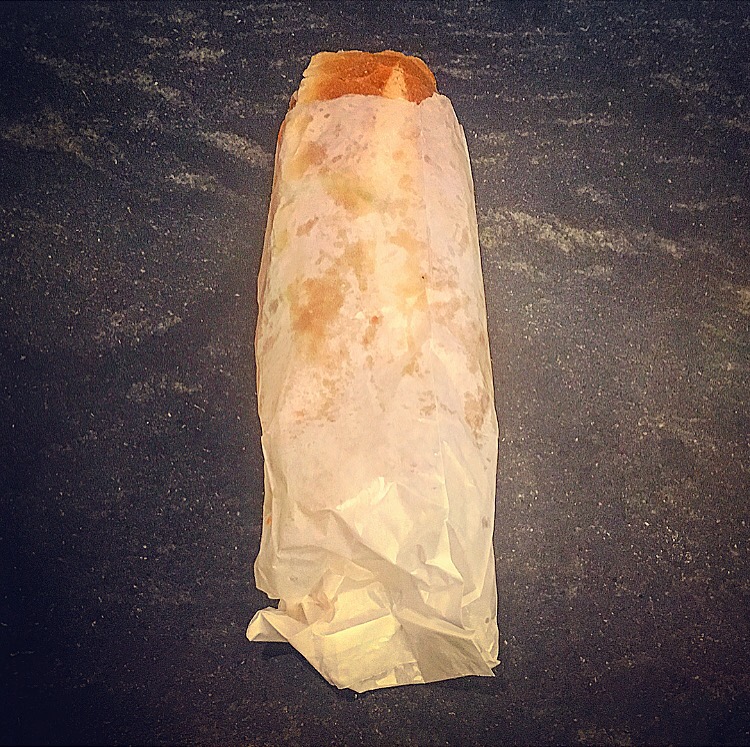
One other similar meat concoction to which I have taken a particular shining over the years, thanks in part to a palate already well-attuned to the glory of such things, is Asian pork pâté. These admittedly visually unsettling, yet borderline inappropriately delicious slices of heaven serve as the silken foundation for a sandwich that has long since replaced Polish Loaf on Pumpernickel, and is engaged in an ongoing battle for supremacy with the Cubano, like the Celtics and Lakers did in the NBA of my youth, in my rankings of all time favorite, alternating based, frankly, on which one I have last eaten: Vietnamese Banh Mi.
Unlike the Cubano, which I happened upon shortly after graduating college in 1999, the Banh Mi is something I discovered after moving to New York City just under a decade ago. And oh what a glorious find. One of many shining examples of a culinary open-mindedness that is as inherent to New York City as it is absent from my native Boston, it is a direct product of the rather ugly side of globalization (colonialism, in fact). A combination of French and Vietnamese influence, truly the best elements of each’s food footprint. Multi-cultural streetfood at its finest.
Like the Cubano, the secret to its appeal, in my opinion, starts with the multiple different pork products tucked between its bready outer layers, cut delicately by a bright, fresh crunch of pickled vegetables. A traditional Banh Mi, executed perfectly by my people at Hanco’s in Brooklyn, has 3: Vietnamese ham and roasted ground pork, anchored in the fold by a slice of dark pink, congealed manna in the form of Asian pâté. Where a Cubano offers sliced pickles and a mustard-based spread, however, Banh Mi has spicy mayo-based sauce, and takes a simpler, cleaner route regarding the pickled element – julienne carrots and daikon radish – and, something I don’t normally tolerate, sprigs of cilantro.
The result is something perfectly balanced – the mayo compliments the meats without overwhelming them, as sometimes occurs in a Cubano; the pickled vegetables and cilantro help cut through what would otherwise be a rather heavy handed ham-bomb, and actually makes the whole thing seem rather light. Lighter than the sometimes greasy, pressed Cubano, and certainly lighter and more healthy than any other sandwich boasting a porcine triple crown.
But for me, what sets the Banh Mi apart from any other sandwich, all due respect to the Cubano, Square Bologna and mayo on Pumpernickel, and cheese and mayonnaise on white, and my ENTIRE GODDAMNED CHILDHOOD, is the bread.
It’s nothing extravagant. It’s actually anything but. Simple sub rolls, (or torpedos, or grinders, or whatever your regional dialect calls them). Six to eight inches in length – big enough for one to sate you, but small enough that one and a half is really ideal. Unadulterated – no toasting nor grilling nor pressing. Just the bread. Which, once you taste really good bread you realize, paradoxically, that the simpler and cleaner it is the more impressive it is.
And a golden crust with, at its best, a slight crispness that teeters ever so precariously on seeming slightly stale, but at the very micro-moment before it would be so, gives way to a soft yet not gummy interior. Crumbly, slightly messy, but texturally perfect, the Banh Mi represents ‘flavor’ in several senses: balance, simplicity, working class roots with cosmopolitan influence. And in this case, actual flavor.
It’s not often a kid can reflect so positively on something so potentially damaging as his mother lying to his face, continually, for years. Luckily not only am I able to understand the positive impact such an incident had on me as a person – pointing out to me the folly of my obstinance, opening both my kind and my mouth to an entire world of foods, drinks, and cultures I otherwise might never have considered, based on something as silly as nomenclature – but I am also able to wildly overstate the nature of that initial dishonesty so as to help illustrate in a rather flowery manner how silly little things in our childhood sometimes end up shaping so much of our adult lives.
Like the butterfly effect. But with pork products. And, of course, the bread. Always the bread. And mayo. Or rather: Mayo, B.
 flavormost