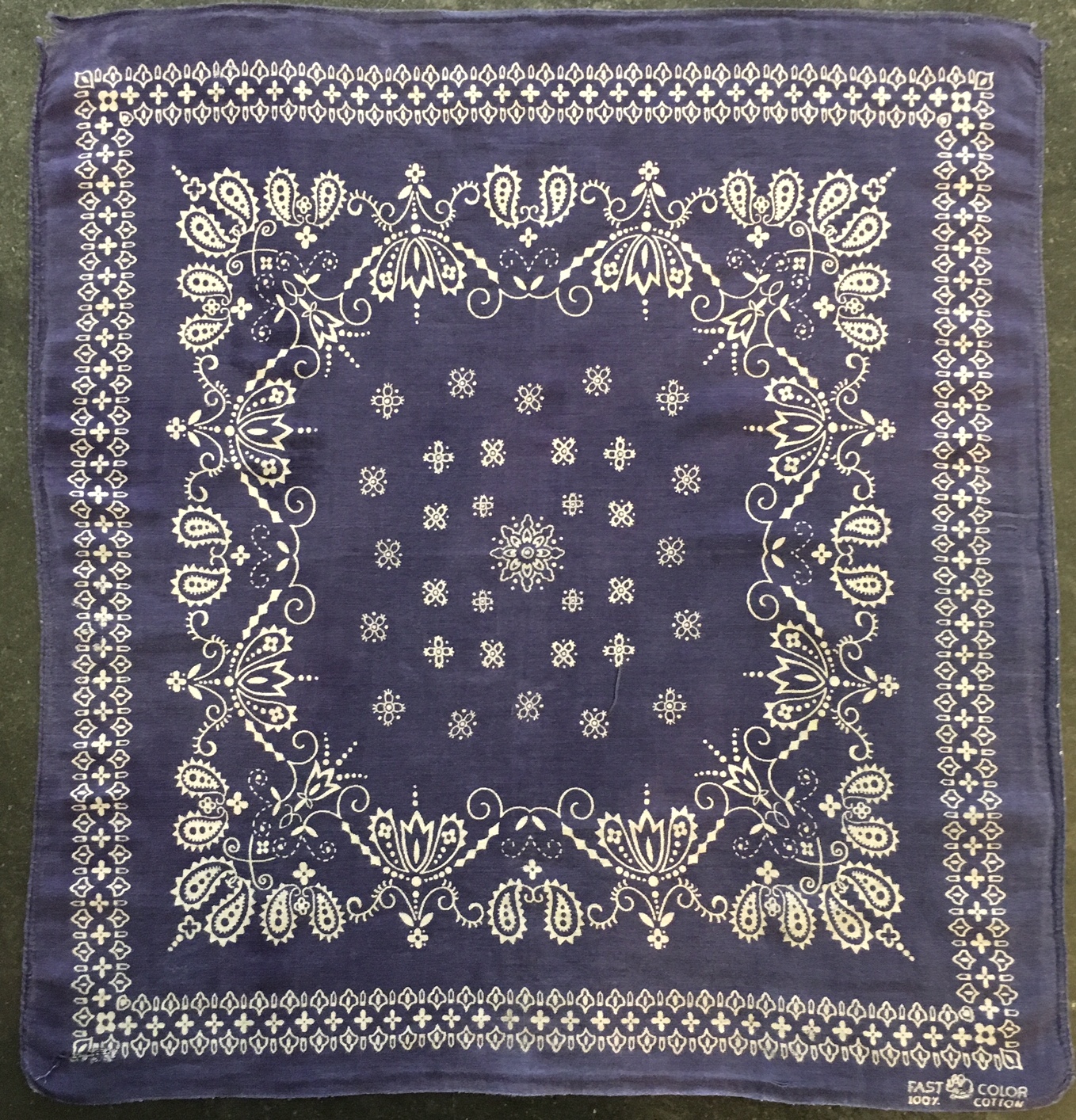
The recurring theme of this blog, if there is one, is nostalgia, and the many manners through which it manifests itself through my own personal style. This is a rather significant component of what I like to call ‘flavor’ – that bit of personality that separates ‘style’ from ‘fashion’, and further separates true ‘style’ (originality, subtlety, and the mixing of disparate elements into a single cohesive look) from merely reading about what is currently ‘in’ and aping that to its fullest, peacockish extent.
Perhaps no other item represents this more to me than vintage bandanas, which I utilize both in lieu of traditional linen handkerchiefs and as pocket squares, and the connection they have to both my youth and my career. As a long-devoted Ralph Lauren style disciple, I have always loved mixing elements of his upper class preppy style with the more urban influences of an adolescence with one eye on the country club and well-tuned sense of the style of the city.
Whether it was building my back-to-school wardrobe from 4th grade onward around his classic polos, rugby shirts, and crewneck sweaters, and pairing them back to Air Jordans and Shelltoes, to wearing a blue bandana passed down from my ailing grandfather under my baseball hat as a 14 year old, to building my current wardrobe around the tried and true principles of the versatility of the navy blazer and blue buttondows (oxford and/or chambray), while still taking great pains to make sure my sneakers and Tims remain crispy fresh, I keep coming back to Ralph’s core aesthetic, mixed with a bit of that hip-hop influence that even as a 40 year old still informs my style.
As an adult, I had the rare opportunity, in working for the man himself and his eponymous brand for almost six years, to witness firsthand the wit and whimsy that goes into this one man’s genius, and the core principle of balance that allows him to continually straddle the line between country club prep, urban sophistication, and haberdashered elegance.
In the world of RL, utility and beauty need not be separated, and in many instances, their RRL line in particular, they are one in the same. The concept is not necessarily new – in fact many of the most time-honored marks of elegant men’s style started off as utilitarian endeavors: trenchcoats, jeans, leather bombers, tweed sportcoats – but nobody, with a nod to Engineered Garments, does it quite like Ralph. Much of his genius is taking items that began their life as purpose-built and imbuing in them an air of elegance that belies their workingman roots.
In a similar Americana spirit: the Fast Color 100% cotton bandana. As utilitarian as it gets, these beauties were the epitome of American-made usefulness for the working class. From wiping sweaty brows, to cleaning the drip off a dipstick, to keeping prairie dust out of your nostrils, to cleaning the grime for your kid’s face, the utility is undeniable. The beauty inherent in each of these unassuming rags represents America itself – the European influence of their varied paisley prints, the character and patina they take on with each wash, and the roll-up your sleeves and get the job done versatility of something every man needs in his back pocket.
For me, in addition to the nostalgia of having clipped off a corner of that blue bandana of my grandfather’s to keep with me while placing the remainder of it lovingly in his casket when he passed back when I was 14, they represent that signature RL mix of high-low to a T – the purvey of both hardcore Cali gangbangers and peacockish NYC dandies alike, as well the workingclass folks who made them in now defunct American factories throughout modern history. And perhaps not surprisingly, these were a favorite of Ralph Lauren stylists as the subtle, go-to accessory that tied together entire looks in any of several ways during my tenure there.
And it was this eye for that detail to which I perhaps owe a good measure of my success at Ralph Lauren, and which may lend even more to my affinity for these beautiful pieces. Attempting to conquer the rather gargantuan task of building a bridge between the wildly talented, art-minded creatives of the legendary RL stylist team with the inherently business-minded and rather obstinate commercial needs of the Factory Store channel, whose Marketing efforts I led, it was the deployment of one of these old, faded bits of sartorial history as a pocket square that caught the eye of hall of fame-level stylist Ben Eskridge, as we got together to slog through what had historically been arduous tugs-of-war Style Outs for our quarterly photoshoots.
Catching Ben’s notoriously detail-oriented eagle eye, he pointed to my breast pocket at the start of the meeting, and said “Dude, I love it.” And with three simple words the walls between his team and mine, built up over years of what felt like competing interests and aims for the channel’s photographic needs, came crumbling down in an instant. From there our teams seemed to work together in a way that eluded the two groups in the past. Ben and his team seemed to relish in the fact that they finally had a partner on the other side of the table who truly “got” the type of style they aimed to represent, and the little details that really made the RL brand – “The Dream”, as Ralph calls it – what it is. It was a stamp of approval for me, and for a business unit that always seemed to feel like its mission statement – drive business growth with value-minded, purportedly brand-lifestyle-blind shoppers – was at loggerheads with the overarching creative goals of an organization devoted to building and maintaining brand appeal first and foremost. We were now on the same page, and began the process of elevating the channel’s assets to a more lifestyle-focused presentation, starting with the “rigs”, and continuing with the timing, tone, and tenor of the messaging.
And the results were staggering. By elevating the Factory Store channel marketing, primarily via its now brand-forward photographic assets, we were able to create the type of aspirational behavior once confined to only the fullest of full-price shoppers. Gone was the notion that, in order to appeal to outlet shoppers, we had to focus on somewhat dumbed-down, democratic looks, that sought merely to capture the most agreeable, basic product, in a much less brand-appropriate manner. Ben’s team was free to do the job they were paid, and passionately loved, to do, and did for every other channel within the organization. And my team was finally free to create assets that showcased what was always most appealing to our customers – the Ralph Lauren lifestyle – even if it was one that few of them actually led. Customers responded in kind, and the rising tide lifted all ships.
Odd indeed that something as proletarian and seemingly insignificant as a vintage bandana was able to lead to the accomplishment of something so seismic and significant. And maybe I am overstating the impact of that moment. I am an adherent of “creating the dream” after all. But it certainly, to this day, is a point of both personal and professional pride that what was a rather throwaway statement of personal style, one that spoke to both my past and my present, led to such significant successes.
And in this way, these beauties represent exactly what this entire editorial exercise represents to me: how one small expression of personal style can have a lasting impact on so many other aspects of one’s life.
So in honor of the inherent flavor of these vintage bandanas, and of my grandfather and my working class pride, once a month I’ll showcase a different vintage Fast Cotton bandana from my personal collection. Beauty in utility, elegance in simplicity, and 100% American made. Not unlike the story of Ralph Lauren himself, and the many stylistic dreams his dream has fathered.
 flavormost