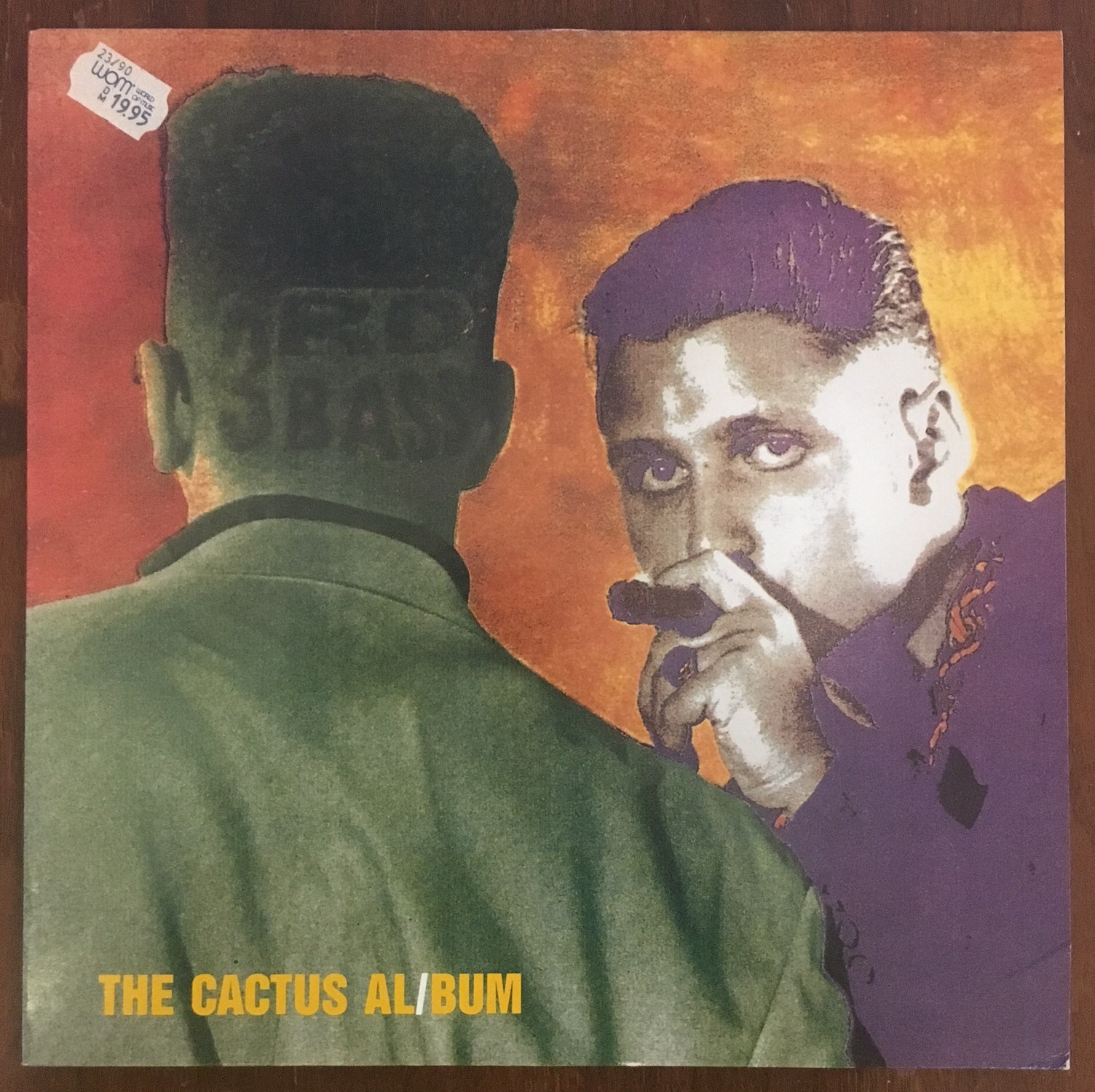
It was, admittedly, a tough call for a long time. Over the years I have vascillated between three albums, normally two, for which is my favorite hip-hop album of all time: Nas’s Illmatic, De La Soul’s Buhloone Mindstate, and 3rd Bass’s The Cactus Album. The silver lining about growing simultaneously older and less impressed by the current state of hip-hop is that the further removed I am from their release dates, the more appreciative I become of the albums of my youth.
The downside of course being that it takes 5 years for me to find the number of quality modern albums as I would in a couple months of my youth. But in some ways that merely sweetens the pot, knowing I cut my teeth in what is truly the Golden Era of the culture. In many ways, these three albums represent the vastness of this era, and the diversity of quality hip-hop of the time between 1988 and 1994. Despite being rather disparate in tone and tenor, and despite the fact that other than all being from legendary East Coast artists and having been released within a single 5 year window, there is not very much similarlity between them. And yet they continue to set themselves apart from many other incredible albums of the same era and beyond in my soul.
At different points over the past 25 years, each has held sway as my favorite for different periods of time, for different reasons. One is a rather obvious choice – the seventh 5 mic record in the history of The Source, but one that perhaps represented the culmination of the prior 6, and sits within the Top 5, if not Top 3, of nearly every hip-hop head of my generation. Illmatic is in many ways on its own level, both for what it is, what it was, and what it represents. Its release was like a massive exhale for an entire generation of hip-hop fans. There will literally never be another album like it, simply due to how quickly information travels nowadays, and how impossible it is to keep such information, especially with a rabid waiting audience, quiet. It is a masterpiece, balancing bragadoccio and humility, from a hungry, very much accomplished, yet still relatively hidden, underground artist from whom heads were fiending for what seemed like years for a full length album, built prior to the digital age in near complete secret, and never leaked despite its lead singles dropping almost six months prior to the album itself. It is everyone’s first love, which somehow doesn’t take any shine off it at all. It’s probably the perfect hip-hop album – balanced, tight, succinct, no wasted space – at once stark and voluptuous. But it’s not my favorite.
The other two get varying degrees of props from heads of my ilk and age, but are a bit more out of left field. Matter of fact, Buhloone Mindstate is perhaps the epitome of the term: a concept album released after De La effectively fell off the pop culture radar (immortalized on wax on the track “En Focus” as POS goes from superstar on the scene with his no-name friend Dres to the forgotten also-ran when Dres’s record is the one banging and POS’s is fading to black), Buhloone is more of a connoisseur’s album. Many people love De La, but even in De La circles, heads tend to either love or hate Buhloone. For me it came out when I was drifting away from De La halfway through high school, only to be rediscovered three years later on the heels of falling back in love with them via Stakes is High, an opus which sits right outside this Top 3, and represents with sweet nostalgia the summer after my freshman year of college, re-connecting with my boys and my love of hip-hop after a year of immersion in the preppy otherness of Colby College. It is special, funky, and uniquely De La.
But it’s no Cactus Album.
Nothing is, really. Perhaps I am a bit biased, as 3rd Bass dropped this gem on the world when I was truly starting to discover my identity as a true hip-hop head – 12 years old, nose open from the aural onslaught delivered a few months prior via a combination of PE, Rakim, and in particular Kool G Rap & DJ Polo’s Road to the Riches, my first real walkman album, I felt something I had never felt before.
This music, the style, the flavor these dudes had – it stirred something in me where I knew I was not just someone who liked to dress the part or listen to whatever was hot or would learn whatever dance one needed to in order to hold his own on the floor. But a head-over-heels, dyed-in-the-wool, pit of my stomach lover of the culture. A culture epitomized, in my adolescent opinion, and reinforced over time as an adult, by 3rd Bass: diversity, creativity, valueing skills and passion and originality over simply knowing what buttons to push and when. A culture so devoted to this concept that a group who looked at first blush like what everyone assumed was “the new Beastie Boys” came out swinging on their first track dissing the pop crossover success of that very group, beloved in legit NY hip-hop circles in their own right. “Screaming Hey Ladies – why bother?” Damn.
One false move and 3rd Bass would have been pop music sweethearts (as they unfortunately came to learn with the incredibly ironic pop success of their ode to the utter wackness of “hit-pop” two years later with “Pop Goes the Weasel”) but dismissed as Beastie wanna-bes by the very culture they claimed to rep. But that didn’t happen – to quote them: they came off, and all the brothers blessed them. Everything about them was LEGIT: from Serch’s ill hairstyle and spectacles to Pete’s fly suits and cane, to the pitch-perfect catchiness of “The Gas Face” and “Brooklyn Queens”, to being the first whote/multi-racial act to really rep NYC hip-hop without overtly trying to appeal to a cross-over, non-hip-hop audience. They were flawless in what they set out to be: real.
You wouldn’t know it listening to Cactus (though a creeping animosity was apparent on the somewhat less compelling follow up Derelicts of Dialect), with the mellow rapport and perfectly-tuned back-and-forth between Serch and Pete Nice, but 3rd Bass was, as it turns out, the product of an arranged marriage. Christened by the happenstance of DJ Clark Kent having skipped out on a studio session scheduled to help Pete Nice build his demo, and coached along by several business-minded A&Rs – two of whom, in Dante Ross and Lyor (Elroy) Cohen, jokingly got the Gas Face on the track of the same name – who saw the potential to capitalize on the rising tide of whiteboy acts, and put Pete in touch with another hungry, white, yet rather accomplished underground MC and Latin Quarter legend (who ironically enough went on to Executive Produce Illmatic himself) in MC Serch.
And what a marriage it was. With the deft melding of their unique styles over the dope, richly constructed, soulful beats and airtight production of Sam Sever and Prince Paul among others, The Cactus Album dropped to instant acceptance and appreciation from even the most grizzled and skeptical NY hip-hop heads, as well as one notably less-grizzled, budding aficionado outside of Boston in myself. From the first moment I heard “Steppin to the AM”, my intro to the group – first as a single on WERS 88.9 At Night, then from the local Sam Goody, its mint green cassingle graphics mimicking a frame from a cinematic countdown sequence – a Pink Floyd “Time” sample in the opening measures, its Slick Rick-esque, shuffling brush-stick snare-driven beat with a funky creeping bassline pushing it forward, and a geniusly-looped horn section on the hook – I was done. This was the type of hip-hop I loved, performed by dudes that looked like me and who got mad love doing it. Style and substance, and 100% original.
Illmatic, which graced us some 4+ years later, was the nuclear annihilation on which we had all been waiting for years, since first hearing Nas eviscerate the landscape on “Live at the BBQ”. And we all know all that. But for me, The Cactus Album, the more I have listened to it as my music tastes matured over the years, remains one of the more singular albums in the history of hip-hop certainly, if not music as a whole. And represents the height of hip-hop creativity, before changing sample laws forbade future beat-makers from building the same kind of diverse, multi-layered, melodic soundscapes that are so sorely lacking in the modern iteration of the genre.
Starting with the beats, as all great hip-hop albums do – expertly crafted in dense but fluid layers of recognizable yet subtle soul samples, TV and film vocal snippets, and catchy bass and horn loops, by Prince Paul, Sam Sever and others, cut up by turntable aficianado-cum-bit player in the movie Juice – DJ Daddy Rich (nee Richie Rich) – they provide the perfect sonic backdrop for the antithetical give-and-take flows of MC Serch and Prime Minister (Sinisterrrrr) Pete Nice.
The technique for all these cats is enough to laud, clearly having cut their teeth learning how to move a crowd at raw, often flat-out dangerous live hip-hop venues like the LQ and Union Square, before ever having the good fortune to be able to flex on wax (a training ground so sorely lacking nowadays it almost hurts). But beyond the unintentional novelty of a LEGIT white hip-hop act, what stands out is the fluidity of their disparate styles and how it all feels like one of the most authentic representations of New York hip-hop specifically, and that era in general, both musically and culturally:
Serch the ebullient b-boy with the rarely seen hi-top Jew-fade; a rambunctious MC full of clever punchlines, considerable crowd command, and annunciation skills – the essence of the street kid who was always playing, but at the same time, you knew, push comes shove, wasn’t. Pete Nice, the dapper Ivy League poet, NYC basketball legend with a complex Dr. Seuss-ical style (more so than simply the “green eggs and swine” line from the afore-mentioned unfortunate crossover “Pop Goes the Weasel”), Ghostface-esque in syllabic complexity but smoother and more baritone with a bit less-efforted nebulosity. Add in the legendary Daddy Rich and the debut of MF Doom as Zev Love X from could-have-been KMD (on “Gas Face”), and its no wonder they dropped a supernova of an album.
But like all supernovas, their flame burned both bright and brief, and after a strong if less accessible follow-up, 1991’s Derelicts of Dialect, they split amidst animosity that exists, unfortunately, to this day. As several podcasts attest, Serch’s stature as storyteller has only grown in the years since, with him recounting with great zeal on podcasts such as Juan Epstein, The Champs, and The Cipher his days at the Latin Quarter, to avoiding a Hammer-funded hit by Rollin’ 60 Crips in 1990 LA, to having ghost-written the lyrics to “Steppin’ to the AM” for Rakim at the behest of a producer, only to draw the ire of hip-hop godfather Eric B at having seemingly fronted on his MC partner, and all the stories of how the two were stitched together by Dante Ross and Sam Sever despite having barely known one another, the story of 3rd Bass is perhaps best told having now come to a full and final conclusion, with the benefit of hindsight’s perspective.
Each has taken a post-3rd Bass path aptly suited to their lyrical identity. Serch has assumed a more noticeable place in pop culture since the split, having signed and helped launch Nas’s career via his “Back to the Grill” posse cut, then lining up the murderers’ row of producers for the epic Illmatic. And more recently/unfortunately, as host of the ego trip Search for the Next White Rapper reality show: Yo! MTV Raps meets, American Idol, meets Jersey Shore. Prominent, still moving crowds.
Pete Nice, in true nicean fashion, now tends to the collective memorial of our national pastime as head of memorabilia and archives for the Baseball Hall of Fame in Cooperstown, NY. Perhaps the most amazing job I could ever think of, though not without its share of controversy surrounding it via claims of thievery, a conviction on charges of tax fraud, and various somewhat large scale financial problems. But at least the baseball nostalgia bar of which he is part-owner, Nuf Ced McGreavy’s in Boston, is thriving – a baseball history buff’s drinking establishment in a town full of baseball history and drinking enthusiasts.
Thankfully, for me anyway, both were reunited relatively recently via their being featured prominently in Bobbito’s classic book “Where’d You Get Those?“, as commentators on city life as sneakerheads well before it became cool (speaking of things that have since died an excruciating death). Again, about as legit as it gets.
And after a single reunion show in 2014 celebrating the 25 anniversary of The Cactus Album, unlike A Tribe Called Quest, who eventually were able to bury the hatchet and move forward just long enough to create more magic before Phife’s untimely passing, the two simply couldn’t get past the scars of those old wounds to get together for even a mini tour.
But for me, it’s just as well, because I don’t think I’d be that excited seeing them try to recapture the magic that lit up the landscape in 1989-90. Their brief union gave us, in my mind, perfection in The Cactus Album. None like it, before or since. Russell perhaps said it best: “3rd Bass is just stupid; that shit’s…3rd…Bass…”
 flavormost